
Imagine checking your lottery ticket and realizing you just won millions of dollars.
After the shock wears off, you might start thinking about what you’ll buy, where you’ll travel, or whether tomorrow is finally the day you tell your boss exactly what you think.
Then another question hits you:
Does everyone have to know I won?
Maybe.
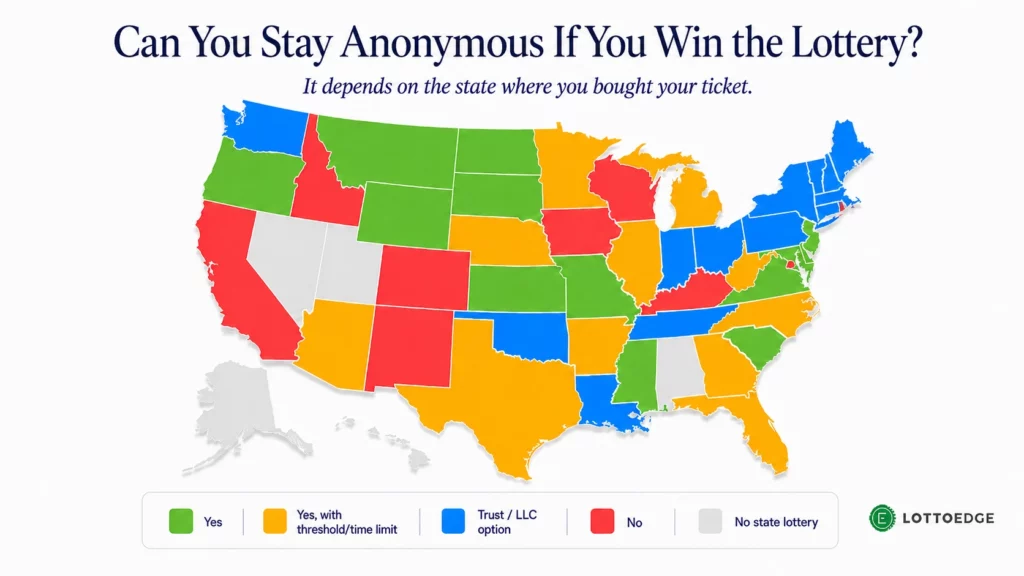
Whether you can remain anonymous after winning the lottery depends largely on where you bought the winning ticket. Some states let winners stay completely anonymous. Others only protect winners above a certain prize amount. And in many states, your name becomes public information.
That’s why this is something worth knowing before you walk into the lottery office with your winning ticket.
Can Lottery Winners Stay Anonymous?
There is no single national rule.
Powerball itself says every lottery jurisdiction has its own laws regarding winner anonymity. Some states require a winner’s name and other information to be made public, while others allow winners to remain anonymous or claim through a trust or other legal entity.
And those rules keep changing.
Several states have expanded privacy protections for lottery winners in recent years. Oregon, for example, changed its law in September 2025 so a winner’s name and address generally cannot be released without written permission.
Here is the current state-by-state picture.
Lottery Winner Anonymity by State
Last reviewed: August 2026. Laws and lottery policies can change, so always confirm the current rules with the lottery where your ticket was purchased before claiming a major prize.
Can’t remain anonymous in your state? Don’t stop reading there. In several states, winners may be able to claim through a trust or other legal entity that provides additional privacy, even when the state doesn’t technically allow anonymous winners.
| State | Privacy Option | What You Need to Know |
|---|---|---|
| Alabama | No state lottery | Alabama does not currently operate a state lottery. |
| Alaska | No state lottery | Alaska does not currently operate a state lottery. |
| Arizona | Yes — $100K+ | Winners of $100,000+ may choose permanent anonymity. Winners of $100,000+ are also confidential for 90 days after claiming if they don’t elect permanent anonymity. (Source) |
| Arkansas | 3 years — $500K+ | Winners of $500,000+ may remain anonymous for three years, after which the records generally become public. (Source) |
| California | No | Your full name, winning retailer, date and prize amount are public record. (Source) |
| Colorado | Partial privacy | Colorado releases limited winner information. A trust, partnership or corporation cannot claim the prize instead of the individual. (Source) |
| Connecticut | Trust/LLC option | Connecticut does not provide guaranteed direct anonymity, but prizes may be claimed through a trust or LLC, which can provide additional privacy. (Source) |
| Delaware | Yes | Delaware law allows all lottery winners to remain anonymous. (Source) |
| Florida | 90 days for $250K+ / Trust option | Florida does not offer permanent direct anonymity. Winners of $250,000+ receive 90 days of confidentiality, and a trust or other entity may provide additional privacy. (Source) |
| Georgia | Yes — $250K+ | Winners of $250,000 or more may choose to remain anonymous. Georgia’s claim form also recognizes legal entities such as corporations, partnerships and trusts. (Source) |
| Hawaii | No state lottery | Hawaii does not currently operate a state lottery. |
| Idaho | No | Idaho does not provide general lottery-winner anonymity. (Source) |
| Illinois | Yes — $250K+ | Winners of $250,000+ may request that their name and hometown remain confidential when claiming. (Source) |
| Indiana | Trust/LLC option | No general direct anonymity, but Indiana winners have successfully claimed prizes through LLCs and trusts, allowing the entity to serve as claimant. (Source) |
| Iowa | No | Iowa does not provide general lottery-winner anonymity. (Source) |
| Kansas | Yes | Winners may request anonymity. (Source) |
| Kentucky | Limited privacy | Winners may decline publicity, but identifying information can potentially be obtained through an open-records request. |
| Louisiana | Trust/entity option | A prize may be paid to a legal entity such as a trust, but this does not guarantee anonymity. Louisiana says the names and cities of people receiving prize funds are public record. (Source) |
| Maine | Trust option | Maine does not provide general direct anonymity, but a trust may claim a prize and become the claimant of record. |
| Maryland | Yes | Winner information is generally not published without the winner’s consent. (Source) |
| Massachusetts | Trust option | No general direct anonymity, but Massachusetts specifically allows lottery prizes to be claimed through a trust. (Source) |
| Michigan | Depends on game | Winners of more than $10,000 in certain Michigan-only games may remain private. Multi-state jackpot winners may have their names public. (Source) |
| Minnesota | Yes — over $10K | Winners of more than $10,000 may remain anonymous. (Source) |
| Mississippi | Yes | Winner information is generally not published without consent. (Source) |
| Missouri | Yes | Winners may remain anonymous. (Source) |
| Montana | Yes | Winners may remain anonymous. (Source) |
| Nebraska | Yes — $250K+ | Winners of $250,000+ cannot be publicly identified without written authorization. Winners below $250,000 are generally public. (Source) |
| Nevada | No state lottery | Nevada does not currently operate a state lottery. |
| New Hampshire | Trust option | Winners generally do not have direct anonymity, but trusts may be used to claim prizes and can provide additional privacy. (Source) |
| New Jersey | Yes | Winners may choose to remain anonymous. (Source) |
| New Mexico | No | New Mexico does not provide general lottery-winner anonymity. (Source) |
| New York | LLC/entity option | No general direct anonymity, but a legal entity such as an LLC may claim a prize, providing additional separation between the winner and the public claimant. (Source) |
| North Carolina | 90 days — $50M+ | Winners of $50 million or more may choose to remain anonymous for up to 90 days after claiming. (Source) |
| North Dakota | Yes | Winners may choose whether to release their information or remain anonymous. (Source) |
| Ohio | Trust option | A trustee may claim a lottery prize. The name of the claimant is public record, so a trust provides additional privacy but not necessarily complete secrecy. (Source) |
| Oklahoma | Trust option | Oklahoma allows prizes to be claimed through trusts, which can provide additional privacy. (Source) |
| Oregon | Yes | Since September 2025, a winner’s name and address generally cannot be released without written authorization. City, state, ZIP code and prize amount may still be disclosed. (Source) |
| Pennsylvania | No / Trust option | Pennsylvania does not provide general direct anonymity, but major prizes have been claimed by trusts. The trust becomes the public claimant, so this can provide additional privacy rather than guaranteed anonymity. (Source) |
| Rhode Island | No | Rhode Island does not provide general lottery-winner anonymity. (Source) |
| South Carolina | Yes | Winners may remain anonymous. (Source) |
| South Dakota | Yes | Winners may request anonymity, and the South Dakota Lottery says it will honor that request. The retailer, game and prize amount may still be released. (Source) |
| Tennessee | Trust option | No general direct anonymity, but major Tennessee prizes have been claimed through trusts, allowing the trust to serve as the claimant. (Source) |
| Texas | Yes — $1M+ | Winners of $1 million+ may request anonymity. Trusts have also been used for large Texas lottery claims. (Source) |
| Utah | No state lottery | Utah does not currently operate a state lottery. |
| Vermont | Trust option | Individual winners cannot remain anonymous, but a trust may claim. If a trust claims, the trust’s name becomes public instead of the individual’s name. (Source) |
| Virginia | Yes | As of July 1, 2026, any Virginia Lottery prize winner may claim anonymously. The Lottery will not release the winner’s name, hometown or prize amount without written permission. (Source) |
| Washington | Trust option | No general direct anonymity. A trust may provide additional privacy, but lottery records are subject to Washington’s Public Records Act, so entity documents could potentially reveal the winner. (Source) |
| Washington, D.C. | No | Specific D.C. Lottery winner information is public record. (Source) |
| West Virginia | Yes — $1M+ | Winners of $1 million or more may qualify for anonymity. (Source) |
| Wisconsin | No | Wisconsin does not provide general lottery-winner anonymity. (Source) |
| Wyoming | Yes | Winners may remain anonymous, and winner information is generally not published without consent. (Source) |
What Does “Anonymous” Actually Mean?
Anonymous doesn’t mean the lottery doesn’t know who you are.
You’re still going to have to prove you own the winning ticket, provide identification, and deal with taxes and other claim requirements.
The question is whether the public gets to know who you are.
Depending on the state, information that could become public may include your:
- Name
- City or hometown
- Prize amount
- Game played
- Winning retailer
Some states protect your name but still announce where the ticket was sold and how much was won.
What About Claiming Through a Trust or LLC?
This is where things get more complicated.
Even in states that don’t allow an individual winner to remain anonymous, it may sometimes be possible for a trust, LLC, partnership, or other legal entity to claim the prize.
That doesn’t automatically guarantee anonymity.
The rules governing legal entities, public records, beneficial owners, and lottery claims vary considerably by state. Powerball specifically notes that some jurisdictions allow prizes to be claimed through trusts or other entities that can provide additional privacy.
If you’ve won a life-changing amount of money, this probably isn’t the time for a DIY legal strategy.
Before You Claim, Talk to an Attorney
If privacy matters to you, don’t wait until after you’ve claimed the prize to investigate your options.
Once your identity becomes public, there’s no putting it back in the bottle.
An attorney experienced with lottery claims can determine whether your state allows anonymity, whether a trust or other entity makes sense, and what steps need to happen before the ticket is claimed.
And don’t assume the rules you read a few years ago still apply.
Lottery anonymity laws continue to change. The Associated Press reported in 2025 that lawmakers around the country have increasingly expanded anonymity protections because of concerns about winners being targeted by criminals, scammers, investors, and people asking for money.
Winning Doesn’t Mean You Have to Become Famous
Winning millions of dollars would change your bank account overnight.
It doesn’t necessarily have to change your identity.
Depending on where you bought your ticket and how much you won, you may be able to collect your prize without the entire world knowing your name.
Just make finding out your options one of the first things you do, not the last.
At LottoEdge, we believe playing smarter means understanding every part of the lottery experience, from finding the games you want to play to knowing what happens if luck finally lands on your side.
Sources & Citations
The state-by-state information above was reviewed using a combination of official lottery sources and current national references as referecned. Lottery laws and claim procedures can change, so winners should verify the rules directly with their state lottery before claiming a major prize.
This article is for informational purposes and is not legal advice. Lottery laws and claim procedures can change.
